
A great distribution center (DC) is more than a big box with racks; it’s a throughput machine. Its job is to take bulk inbound, turn it into store or customer ready outbound, and do it fast, accurately, and at a cost that keeps margins happy. Lets take a tour of what makes a DC tick and the characteristics you’ll see in high-performing operations.
What is Crossdocking ? (Read our Article here)
Crossdocking is a logistics method where incoming freight is unloaded, sorted, and shipped out with little to no storage time. Instead of sitting on shelves, products flow directly from the receiving dock to outbound transportation.
Benefits of crossdocking:
- Faster delivery – Goods reach stores or customers within hours.
- Lower storage costs – Reduces the need for warehousing.
- Fewer handling steps – Less damage and labor.
- Improved inventory turnover – Products move quickly and efficiently.
1) Location that serves the lane, not the map: The first characteristic is where it lives. A DC sits near the movement interstates, parcel hubs, rail ramps, ports, or the densest pockets of demand so you hit delivery windows without paying for premium modes. Proximity to carriers and labor pools matters just as much as square footage; shaving 30 minutes off every line haul or parcel pickup adds up.
2) A layout built for one-way flow: Good DCs feel like airports with clear signage and no U-turns. Freight moves in a straight progression; receiving → QA → put away → pick → pack → ship; with inbound and outbound staging separated so they never choke each other. You’ll also see a protected fast lane for cross-dock or same-day turns that bypass storage entirely.
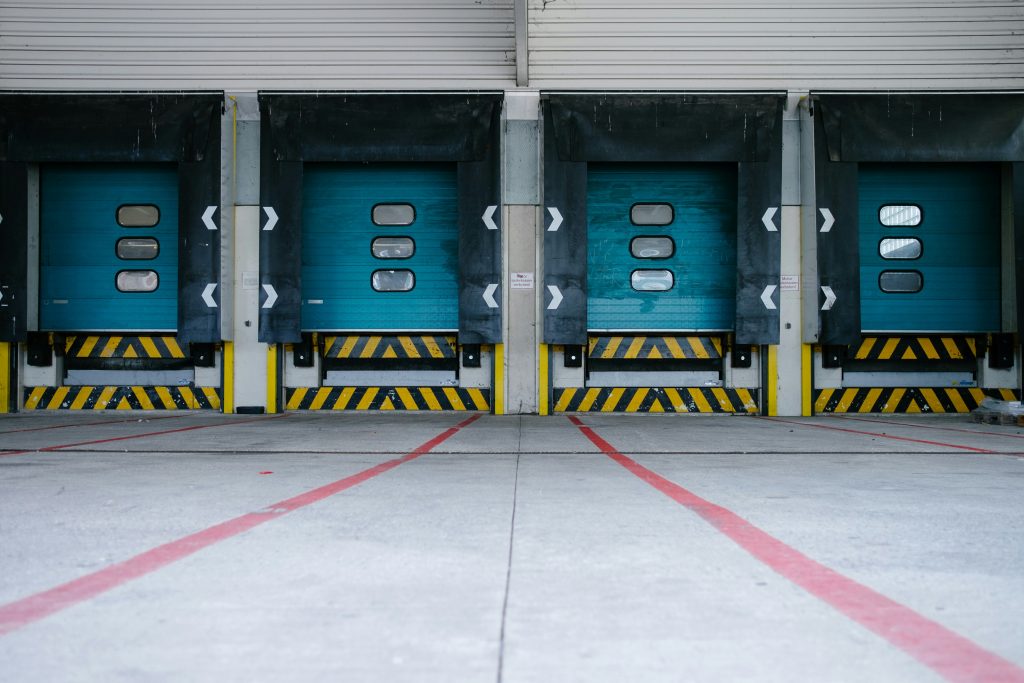
3) Dock infrastructure that speeds turns: Busy doors are the DC’s heartbeat. Expect numbered docks, staged lanes, vehicle restraints with interlocked red/green lights, and the right levelers (hydraulic or vertical in cold chain). Smart yards have trailer parking, deep aprons, and clear circulation so trucks aren’t playing Tetris at 4:55 p.m. The result is lower dwell, fewer missed cutoffs, and calmer afternoons.
4) Storage modes that match the SKU mix: Distribution centers balance density with access. The forward pick area holds a few days of demand close to pack, while bulk reserve sits behind or above. It’s all about short walks and minimal replenishment drama. You’ll find a blend of:
- Selective pallet rack for general flexibility
- Double-deep or drive-in for high-volume, low-mix SKUs
- Carton flow near pack for case/each fast movers
- Static shelving or bins for small parts
- Bulk floor storage for oversize or fast-turn pallets
5) Velocity-based slotting: Top performing DCs slot SKUs by velocity and affinity (items often ordered together). A items live in the golden zone (waist to shoulder) near pack; slow movers can live higher or farther. Slotting isn’t set-and-forget teams reslot after seasonal shifts or product launches to keep travel distances down and pick rates up.
6) Multiple pick methods (used intentionally): There’s no single “best” pick style. DCs deploy what fits the order profile:
- Pallet pick for wholesale or store replenishment
- Case pick for B2B or marketplace orders
- Each pick for e-commerce or spares
- Batch, wave, or zone picking to group work efficiently
- Light-directed or voice where speed and hands-free help
The key characteristic isn’t the tool it’s consistency. One clean method per zone beats five half-used methods every time.
7) Pack & ship that runs like an assembly line: Packing stations are standardized so everything is within one arm’s reach printer, scanner, scale, tape, dunnage. Cartonization rules pick the right box the first time, cutting DIM charges and damage. Outbound lanes are labeled by carrier, service, and cutoff, and loads are built in trailer sequence so teams aren’t restacking at the door.
8) WMS led discipline: If it moved and didn’t scan, it didn’t happen. A distribution center’s brain is the WMS, directing put away, picks, replenishments, and cycle counts. Barcodes (or RFID) at every level pallet, case, inner, location keep inventory truthful. For many DCs, the WMS also talks to TMS (labels, rate shop, appointments) and sometimes WES/WCS when conveyors or AMRs enter the chat.
9) Inventory accuracy you can plan a P&L on: DCs live or die by inventory accuracy. You’ll see cycle counts (often ABC-based), clean location logic, and scan prompts for lot/serial and expiry where needed. That discipline prevents “ghost stock,” mis-picks, and the expensive game of overnighting what “should have been there.”
10) Value-added services where they make sense: Many DCs do light transformation because it reduces friction downstream relabeling to retailer standards (UCC-128/SSCC), kitting bundles or promo packs, rework and QC, or channel-specific packaging. The trick is to keep VAS near forward pick and pack so you add value without creating traffic jams.
11) Cross dock capability for speed plays: A hallmark of modern DCs is a cross-dock flow: receive, verify, sort, and reload; often in hours. It’s perfect for retail appointments, late containers, and seasonal drops. Proper cross-dock lanes, pre-assigned sort logic in the WMS, and staffing to departure (not office hours) turn “we’re behind” into “we left at 1:12 p.m.”
12) Compliance and product integrity: Whether it’s food, pharma, hazmat, or high-value goods, DCs carry the controls: FEFO rotation, temperature zones, sanitation, segregation, cage storage, and audit trails. Compliance isn’t a sign on a wall it’s prompts in the workflow and documentation you can pull in a minute.
13) Safety baked into the floor plan: You’ll notice guarded rack ends, marked pedestrian crosswalks, mirrors at blind corners, and clear egress. At the docks: restraints, light systems, toe guards, and maintenance struts. Safety here isn’t a speed brake; it’s how you avoid the stoppages and claims that quietly wreck throughput.
14) Resilience you don’t have to think about: The best DCs plan for curveballs: backup labelers and scanners, generator-ready power, redundant internet, and simple manual SOPs for short outages. Inbound, returns, and outbound have separate zones so one problem doesn’t poison the others. That’s how you keep hitting cutoffs even on weird days.
15) Sustainability that shows up as savings: LED lighting and motion sensors, HVLS fans, right sized packaging, smarter consolidation, battery charging schedules green choices here usually reduce utility bills, damage, and empty miles. Many parks add EV charging or solar-ready roofs that extend the edge.
16) KPIs that operators actually use: Distribution centers watch a short list of numbers daily because those numbers move the business:
- Dock to stock time (inbound → available to pick)
- Pick accuracy and perfect order rate (on time, complete, undamaged, correct)
- Lines picked per labor hour (by zone)
- On time departures vs carrier cutoffs
- Door turns & dwell time
- Inventory accuracy (cycle-count deltas)
- Damage/claim rate
The culture is: post yesterday’s numbers, fix today’s constraint.
17) Scalability without chaos: Good DCs are modular. You can expand forward pick faces, add a second pack line, open more doors, or stand up a temporary swing space for peak without redesigning everything. If automation is in the cards later, the slab, power, and aisle plan were already designed to welcome it.
18) People systems that make everything else work: Layout and tech are only as good as the crew running them. Strong DCs invest in cross-training so labor flexes to the longest queue, run short shift huddles to set goals and address blockers, and write one-page SOPs with photos so new hires can contribute quickly. The feel on the floor is calm and purposeful, even when volumes pop.
Distribution center vs. generic warehouse : What’s the practical difference?
Both store inventory, but DCs are optimized for movement. You’ll see more doors, more pick faces, tighter integration with carriers, and workflows engineered around cutoff times. A generic warehouse can act like a DC, but a true DC makes throughput the design priority from day one.